
Last updated: 2026-09-21
Why Does Trigger Finger Make a Finger Catch and Then Snap Straight?
When a finger catches in a bent position in the morning and then snaps straight with a click, trigger finger is the first condition we look at. The mechanism behind this symptom is that the flexor tendon, which bends the finger, catches as it passes through the narrowed passage of the A1 pulley on the palm side.
Some people in their 50s wake up, open their fist, and find that the ring finger won't straighten and catches near the base of the finger. Applying force or pushing the finger up with the other hand makes it snap straight, and a small, pea-sized nodule is felt on the palm side at the base of the finger. This catching and pain come from friction between the tendon and the pulley.
Running through the inside of the finger is the flexor tendon, which bends the finger joints. The tunnel-shaped fibrous tissue that holds this tendon close to the bone is the A1 pulley. Normally, the tendon glides smoothly through this passage. When irritation continues and the A1 pulley thickens or a bump-like nodule forms on the tendon surface, the passage narrows. When the finger is straightened, the nodule forces its way through the narrowed pulley, catching and then suddenly releasing, which produces a clicking sensation. When the catching is severe, forcing the finger straight with effort further damages the tendon surface.
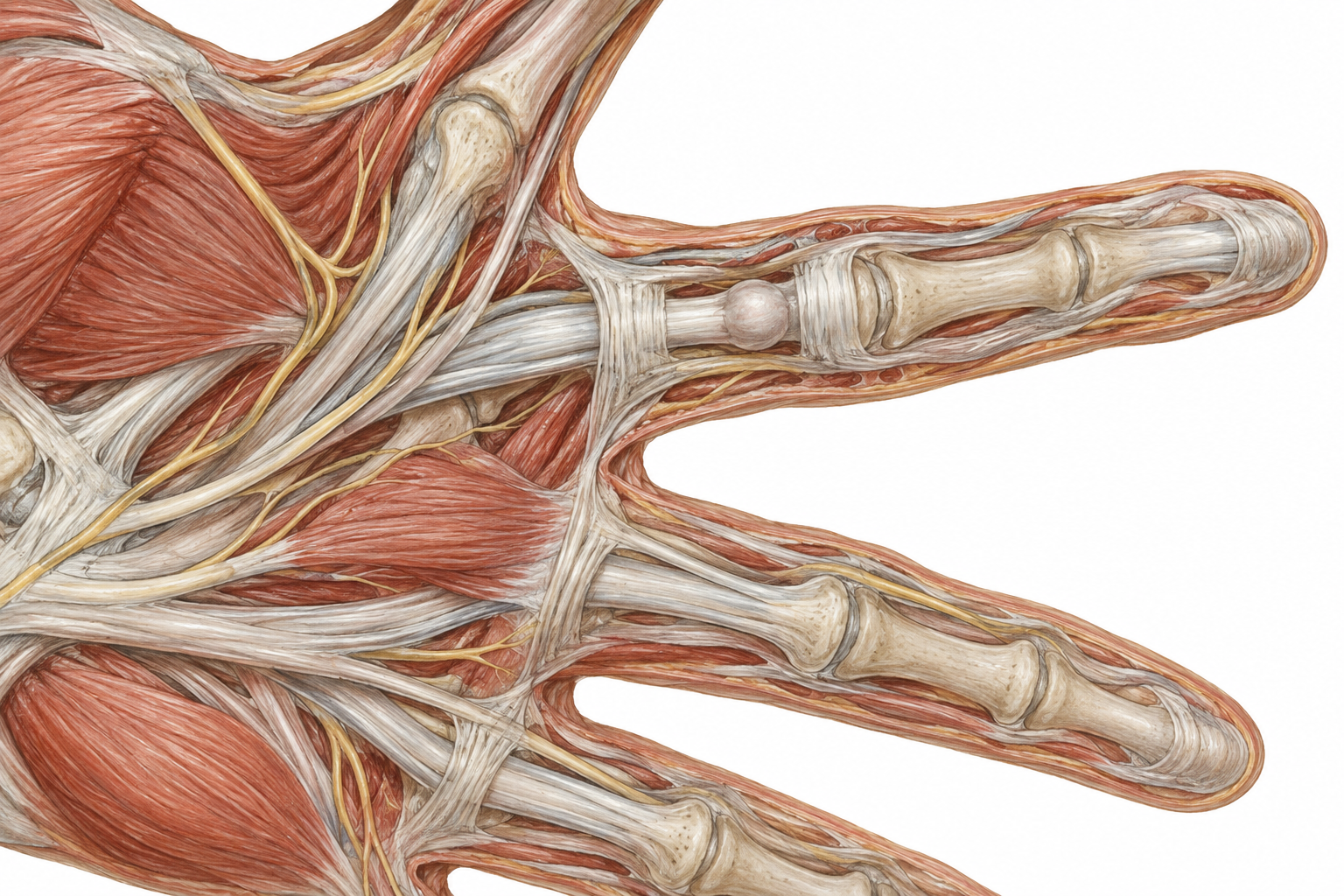
Flexor tendon with a nodule catching at the first pulley at the base of the finger — AI-generated medical illustration
Symptoms start with pain and the finger catching as if pulling a trigger. As the condition progresses, the finger can lock and fail to either bend or straighten, and joint movement becomes restricted. Because the hand stays still overnight, fluid builds up around the tendon, so stiffness and catching are worst in the morning. As the swelling goes down during the day with use of the hand, the finger loosens up a little.
It is more common in women than in men, and more frequent in people in their 50s and 60s and in those with diabetes. Systemic conditions such as diabetes or rheumatoid arthritis alter the connective tissue in the tendon and nodule area. Habits that repeatedly put pressure and friction on the base of the finger, such as repeatedly gripping scissors to cut, turning a screwdriver hard, wringing out a rag, or squeezing the steering wheel hard with the palm, also build up strain on the tendon (Makkouk Al Hasan et al., 2008).
How Is It Different from Wrist Tenosynovitis and Carpal Tunnel Syndrome?
To tell hand problems apart, we look at where it hurts and whether there is any change in sensation. Trigger finger is characterized by localized tenderness at the base of the finger, where it meets the palm, and by catching of the finger itself.
In De Quervain's disease, the classic form of wrist tenosynovitis, pain gathers on the thumb side of the wrist rather than at the base of the fingers. When you fold the thumb into the palm and bend the wrist down toward the little finger, a stabbing pain arises in the tendon passage on the outer side of the wrist. Unlike trigger finger, where the finger joint clicks and locks, the pain here comes on when the wrist is twisted or bent back.
Carpal tunnel syndrome is not a condition in which a tendon catches but a nerve disorder, in which the median nerve passing through the carpal tunnel of the wrist is compressed. Instead of catching at the base of the fingers, it brings a tingling or numb feeling to the thumb, index finger, middle finger, and the half of the ring finger next to the middle finger, the areas the median nerve supplies. Waking at night with tingling fingertips, or needing to shake the hand to bring the feeling back for a while, is the pattern of carpal tunnel syndrome. Tendon clicking and sensory changes from nerve compression are different symptoms.
When catching and pain appear not in one finger alone but in several fingers or both hands, we also ask about a history of systemic diseases such as diabetes or rheumatoid arthritis. When inflammation affects several tendons at the same time, we check whether a systemic disease has affected the connective tissue. It is also not uncommon for carpal tunnel syndrome or wrist tenosynovitis to be present alongside it.
What Does Ansim Teunteun Pain Clinic Use to Confirm the Diagnosis?
First, we press the joint at the base of the finger on the palm side to find the tender spot and feel for a firm tendon nodule. Next, we have the patient bend the finger fully and then straighten it slowly, and we check for the catching and clicking that occur as the tendon passes through the pulley. We grade severity by whether the patient can straighten the finger fully on their own, whether it straightens only when pushed with the other hand, or whether it stays locked in a bent position even when the other hand is used.
Typical trigger finger is diagnosed from history and physical examination alone. At Ansim Teunteun Pain Clinic, we add ultrasound diagnosis to look at structural changes. Ultrasound is a test that shows, in real-time imaging, the thickness of the flexor tendon, how much the A1 pulley area has thickened, the size of the nodule on the tendon surface, and the swelling and inflammatory fluid inside the tendon sheath.
During the exam, when the finger is bent and straightened, the ultrasound screen captures the moment the flexor tendon snags at the thickened entrance of the A1 pulley, pauses, and then slides through. It is a radiation-free test that shows the tendon's motion and the mechanism of catching while the finger moves. The tendon sheath thickness and the catching location measured on this screen serve as the reference for deciding where to place an injection and where to apply shockwave therapy.
If symptoms began suddenly after an injury, such as the hand being struck or bent back, or if the lump felt in the palm is much firmer than a usual nodule and the pain lies outside the typical area, we look for other causes. Traumatic lesions such as micro-fractures of the finger bones, tumors within the tendon sheath, and soft-tissue tears can produce similar symptoms, so in atypical cases we re-examine the clinical findings (Makkouk Al Hasan et al., 2008).
When Are Injections and Shockwave Therapy Used?
If the finger is not fully locked in place, treatment starts with lifestyle changes that reduce how hard you grip and how often you repeat the movement. Use tools with thicker handles, and open your hand to rest it during tasks. We recommend a night splint that holds the finger straight so the tendon does not swell from staying bent overnight, and we match the extent and duration of wear to how much the finger's movement bothers you (Gil Joseph A et al., 2020).
If catching and pain persist despite lifestyle changes and splinting, we use ultrasound-guided injection. Watching the space around the tendon sheath at the A1 pulley in real time on the ultrasound screen, we place the medication at the exact spot. We give one to three injections, checking progress at one- to two-week intervals. Steroids are used to reduce inflammation and swelling around the tendon sheath, widening the passage the tendon runs through. Because repeated injections over a short period can weaken tendon fibers and cause skin discoloration around the site, we limit the number of injections.
In a Cochrane analysis, the injection combining steroid and lidocaine had a higher treatment success rate at four weeks than lidocaine alone, with a relative risk of 3.15. The analysis pooled two small studies with 63 participants in total, and one of those studies followed patients for up to four months (Peters-Veluthamaningal Cyriac et al., 2009).
For patients with severe diabetes who should avoid steroids, or whose tendon sheath and surrounding fascia remain stiff after an injection, we add shockwave therapy. At Ansim Teunteun Pain Clinic, we apply focused shockwave therapy, which concentrates energy on a small area, to the thickened A1 pulley, and radial shockwave therapy, which spreads over a wider area, to the fascia around the palm and wrist. The therapy applies physical stimulation to tendons and surrounding fascia that have degenerated from chronic irritation, increasing local blood flow and triggering a healing response.
In a randomized study of 40 trigger finger patients who could release the catching on their own, both the shockwave group and the steroid injection group improved in pain, catching frequency, and daily function through six months after treatment, with no difference between the two groups (Yildirim P et al., 2016). These results come from patients whose finger can still be corrected, not from those with a complete lock where the finger cannot be straightened.
For patients for whom further steroid injections are difficult and whose tendon sheath damage has become chronic, we choose autologous blood-based regenerative treatment. It separates and concentrates regenerative cells and growth factors from the patient's own blood and injects them around the tendon sheath under ultrasound guidance, so the risk of rejection is low. If the finger joints stay stiff even after the catching clears, treatment continues into rehabilitation therapy. This stage uses hands-on joint mobilization and relaxation therapy to restore the range over which the finger can bend and straighten.
After an ultrasound-guided injection, the treated area may throb, swell slightly, or bruise for a day or two. During this period, avoid overusing the hand and skip bathhouses and saunas. If the pain does not ease after several days, or the base of the finger turns red and swollen with worsening heat, or a systemic fever comes with these symptoms, contact the clinic that same day.
When Should Surgery Be Discussed If the Lock Does Not Release?
If the finger keeps catching in a bent position even after non-surgical treatment, including ultrasound-guided injections and extracorporeal shockwave therapy, and it straightens only with force from the other hand or does not straighten at all, we discuss tendon sheath release with an external surgical facility. In a fixed lock where the finger stays fully bent and will not straighten, we book a surgical consultation first instead of spending time completing a set number of non-surgical treatment sessions.
Tendon sheath release is a procedure that opens the fibrous tunnel of the A1 pulley, which restricts the movement of the flexor tendon, along its length so the tendon can glide without catching. For adults with trigger finger that does not improve with conservative treatment, open A1 pulley release is the standard surgery. In this procedure, the surgeon makes a skin incision to see the pulley directly and open it (Gil Joseph A et al., 2020).
Care at Ansim Teunteun Pain Clinic covers diagnosis and non-surgical treatment using injections and shockwave therapy. If we judge that the tendon lock is severe enough to require surgery, we direct patients to consult an external surgical facility. While patients wait for a surgical consultation, we advise them to reduce finger use, and we adjust the intensity of non-surgical treatment to the pattern of the locking so that the damage does not progress further.
When a finger stays bent and locked for a long time, the capsule and ligaments of the proximal interphalangeal joint, the middle joint of the finger, stiffen along with the tendon, and joint contracture develops (Makkouk Al Hasan et al., 2008). Once joint contracture progresses, a range-of-motion limit remains, and the finger does not fully straighten even when surgery opens the A1 pulley. Therefore, when a fixed lock develops in which the finger catches and cannot straighten at all, or when signs of joint stiffening appear, we discuss surgery rather than remaining with conservative treatment.
Jinyeol Kwon · Anesthesiology and Pain Medicine Specialist · Ansim Teunteun Pain Clinic
References
- Makkouk Al Hasan, Oetgen Matthew E, Swigart Carrie R (2008). Trigger finger: etiology, evaluation, and treatment.. Curr Rev Musculoskelet Med. PMID: 19468879
- Gil Joseph A, Hresko Andrew M, Weiss Arnold-Peter C (2020). Current Concepts in the Management of Trigger Finger in Adults.. J Am Acad Orthop Surg. PMID: 32732655
- Peters-Veluthamaningal Cyriac, van der Windt Daniëlle A W M, Winters Jan C (2009). Corticosteroid injection for trigger finger in adults.. Cochrane Database Syst Rev. PMID: 19160256
- Yildirim P, Gultekin A, Yildirim A (2016). Extracorporeal shock wave therapy versus corticosteroid injection in the treatment of trigger finger: a randomized controlled study.. J Hand Surg Eur Vol. PMID: 26763271
Frequently Asked Questions
Q. Can it be trigger finger if there is almost no pain, only clicking?
If the finger repeatedly catches when you bend and straighten it, it may be trigger finger even with little pain. Diagnosis does not rest on the clicking sound alone. Instead, we examine whether the tendon actually catches and whether the finger can be fully straightened.
Q. Can trigger finger get better on its own if you rest your hand?
Mild cases sometimes improve just by cutting back on forceful gripping and repetitive hand use. Pain relief alone does not mean recovery if the catching persists. See a doctor if you need your other hand to straighten the finger or if the locking does not release.
Q. Do I need to keep wearing a trigger finger splint during the day as well?
Not every patient wears the splint continuously during the day. We ask whether the catching happens only in the morning or also when working during the day, and about any discomfort with hand use, and then set the wearing schedule. If numbness or skin pressure develops while wearing it, we adjust the size of the splint and how tightly it is fastened.
Q. If symptoms improve after an injection and then return, do you repeat the same injection right away?
We do not repeat the same injection right away just because symptoms come back. First we review the type and number of previous injections and how long the improvement lasted, then examine the current degree of locking before deciding whether another injection is appropriate. If there is fixed locking, where the finger cannot straighten, we schedule a surgical consultation before considering repeat injections.