
Last updated: 2026-11-05
When I Raise My Arm, My Hand Goes Numb and Loses Strength
If your hand goes numb and your arm loses strength when you dry your hair or hold a subway handrail, you need to check whether it is thoracic outlet syndrome. This condition develops when the nerves and blood vessels that pass from between the neck and chest down to the arm are compressed. It is exactly what is happening when an office worker in their 40s feels a tingling numbness along the inner arm and the little-finger side of the hand and a heaviness in the arm while standing and holding a handrail on the way to work or holding a hair dryer in the morning, yet finds that the discomfort eases once the arm is lowered.
The brachial plexus (the bundle of nerves running from the neck to the arm), together with the subclavian artery and vein, passes through the thoracic outlet, a narrow passage between the neck and chest. Within this passage, the structures are compressed mainly between the anterior and middle scalene muscles at the side of the neck, in the gap between the collarbone and the first rib, and beneath the pectoralis minor, a muscle at the front of the chest. Raising the arm narrows the anatomical space of this passage and increases tension on the nerves and vessels passing through it, which brings on the symptoms.
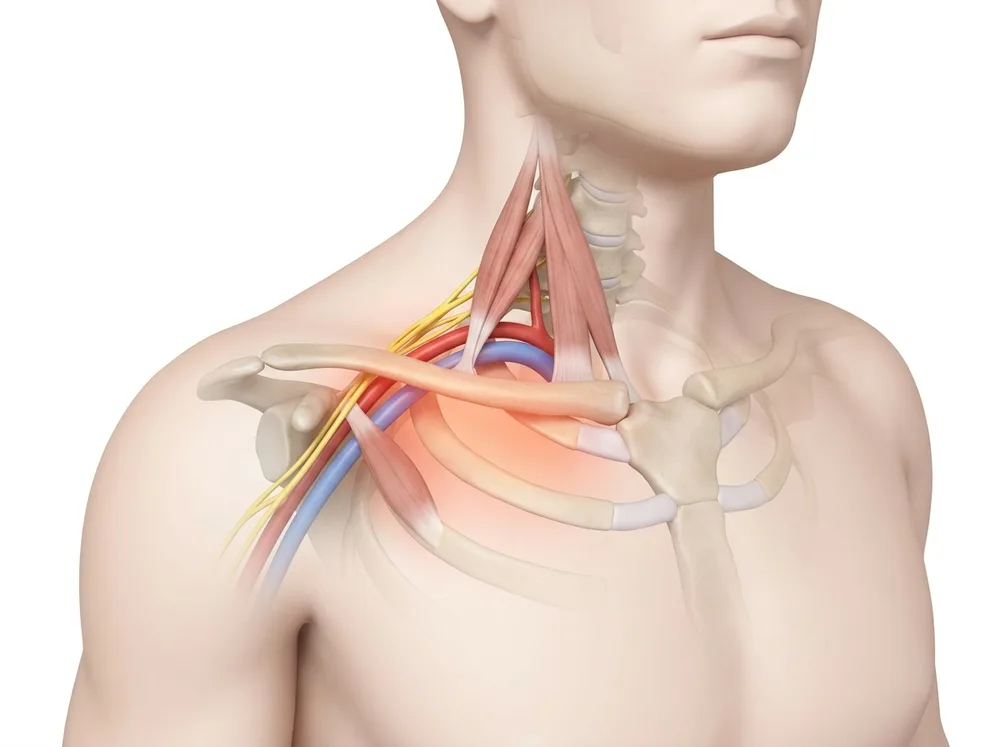 The nerve bundle (yellow), artery (red), and vein (blue) passing through the narrow space between the collarbone and first rib. AI-generated educational illustration
Thoracic outlet syndrome is classified as neurogenic, venous, or arterial, depending on which structure is mainly compressed. The literature reports that the neurogenic type, in which the nerve bundle is compressed, accounts for well over 90% of all patients, while the arterial type, in which the artery is compressed, is rare at 1% or less.(Sanders RJ et al., 2007) After trauma to the neck, such as a car accident, fine damage and scar tissue can form in the scalene muscles and compress the nerve bundle. In addition, a congenital bony variation, such as an extra cervical rib growing from a neck vertebra, can physically narrow the passage and bring on symptoms.
Numbness at Night Points to the Wrist, Numbness When Turning the Head Points to the Neck — What About Raising the Arm?
When your hand goes numb, checking which fingers are mainly numb and in which postures the symptoms get worse goes a long way toward distinguishing thoracic outlet syndrome from cervical disc herniation or carpal tunnel syndrome. Carpal tunnel syndrome is a condition in which the median nerve is compressed in a narrow passage at the front of the wrist, so numbness mainly affects the thumb, index finger, and middle finger. In particular, the hand goes numb at night rather than during the day and wakes you from sleep, and shaking or flicking the hand eases the numbness for a while.
In cervical disc herniation, a disc (the soft cartilage between the vertebrae) in the neck protrudes and presses on a nerve root running from the neck to the arm, causing numbness in the arm. Because of this, tilting the head back or turning the neck toward the painful arm brings on pain around the neck and shoulder blade, and the numbness running down the arm also becomes more pronounced. Depending on which numbered nerve root is compressed, the numbness may affect the thumb side, or the middle finger or little-finger side.
Thoracic outlet syndrome, by contrast, is typically marked by numbness in the inner arm and on the side of the fourth and fifth fingers that worsens when you raise the arm overhead or use the hand for a long time.(Campbell K et al., 2025) Conversely, symptoms can also worsen in a posture where a heavy bag held in the hand pulls the arm downward, because the passage around the collarbone is stretched. If the little-finger side is numb but the numbness worsens when the elbow stays bent for a long time rather than when the arm is raised, cubital tunnel syndrome, in which the ulnar nerve is compressed on the inner side of the elbow, is the first thing to suspect. In addition, if the main symptom when raising the arm is pain in the shoulder joint itself, without nerve numbness running down to the fingertips, it needs to be distinguished from shoulder impingement syndrome.
One study examined 100 arms of 61 women with confirmed carpal tunnel syndrome and found that many of the arms also showed symptoms and examination signs similar to those of thoracic outlet syndrome. However, none of those arms were confirmed to have neurogenic thoracic outlet syndrome with clear nerve damage.(Seror P, 2005) Nerve compression in the neck and compression of a peripheral nerve, such as at the wrist, can also appear at the same time in one patient, so the posture that brings on the symptoms and the extent of the numbness need to be weighed together.
Can a One-Minute Arm-Raise Test Alone Confirm the Diagnosis?
Rather than being concluded from a single test, thoracic outlet syndrome is diagnosed by combining the symptom history, the physical examination, and the results of tests that rule out other conditions.(Sanders RJ et al., 2007) In a provocative test, the arm is raised 90 degrees out to the side, rotated outward, and held there to check whether the pain and hand numbness you usually experience are reproduced as they are. According to the literature, symptoms usually appear within 60 seconds of holding this provocative position. The upper limb tension test, which puts tension on the nerves of the arm, is used alongside it to check whether a nerve is compressed.
The long-known Adson test checks for a change in the pulse while the head is turned, but it often gives a positive result even in people with no symptoms at all, so its diagnostic specificity is low.(Sanders RJ et al., 2007) Even when a local anesthetic is injected into the muscle to see whether the symptoms decrease, it is difficult to confirm the diagnosis on that alone. A meta-analysis that pooled 12 studies and 950 patients found that scalene and pectoralis minor block injections had a diagnostic sensitivity of 87% but a specificity of 34%. Therefore, even if the symptoms change after the injection, the result is interpreted as supplementary diagnostic information added to the history and examination findings.(Nagarsheth KH et al., 2026)
Recently, methods that use ultrasound to look directly at changes in the muscles at the side of the neck are also being studied. One study compared the ultrasound findings of the anterior scalene muscle between 50 patients with symptoms and 50 controls without symptoms. When the images were read by an experienced specialist reader, sensitivity and specificity were each reported to be 96%.(Campbell K et al., 2025)
Along with the arm-raise provocative test, we directly examine the neck and hand for sensory abnormalities and muscle weakness. When needed, we use X-rays to check the alignment of the cervical spine and whether a congenital cervical rib is present. We then use ultrasound diagnosis, which involves no radiation exposure, to observe in real time how the scalene muscles and the muscles around the shoulder actually move. If you bring MRI, CT, or X-ray images taken previously at another medical institution, we carefully compare them with the current physical examination findings and reflect them in the differential diagnosis.
When the Arm Swells and Turns Blue, or Hand Muscles Look Sunken
If the whole arm swells, the skin turns bluish, and a heavy pain develops, it may be the venous type, in which the subclavian vein is compressed or blocked.(Sanders RJ et al., 2007) Conversely, if the hand becomes unusually pale and cold and the pain grows worse, it may be the arterial type, in which blood flow in the artery to the arm is impaired.(Sanders RJ et al., 2007)
These vascular types of thoracic outlet syndrome carry a risk of an accompanying thrombus, a blood clot that forms inside a blood vessel. So if one day one arm suddenly and visibly swells and turns blue, or the hand turns pale and cold, do not wait for outpatient follow-up; get emergency care that same day to have the condition of the blood vessels checked.
Even without vascular symptoms, if prolonged nerve compression damages the motor nerves, the signs that result also need close attention. If the palm muscles at the base of the thumb or little finger look visibly sunken compared with the other hand, or if fine hand movements, such as using chopsticks or buttoning a shirt, become more and more clumsy, nerve function needs to be evaluated promptly. Even before reaching this stage, if hand numbness keeps coming back every time you raise your arm and gets in the way of your daily work or disturbs your sleep at night, you should visit an outpatient clinic to identify the exact cause and start treatment.
How Are Injection and Corrective Treatments Done When Tight Scalene Muscles Cause Numbness?
When pain and hand numbness are severe enough to make daily life difficult, at Ansim Teunteun Pain Clinic we treat them with a nerve block. A specialist injects medication around the irritated nerve while viewing the anatomical position with a C-arm imaging device. The procedure takes about 5 to 10 minutes, and you go home the same day after the procedure. Temporary pain or bruising may occur at the injection site. We usually give 1 to 3 treatments at 1- to 2-week intervals and then check how the symptoms have improved. In addition, when myofascial pain or ligament inflammation around the neck and shoulders accompanies the condition, we perform ultrasound-guided injection, delivering medication while viewing the target area directly on ultrasound.
If a problem with neck alignment, such as forward head posture or a straight neck, has narrowed the passage through which the nerves and blood vessels run, we use spinal adjustment as part of treatment. We set the direction of correction based on X-ray and body-shape analysis results, and carry out manual therapy in which the physician takes part directly, 1 to 2 times a week for 4 to 8 weeks, to help restore alignment and function in the neck and shoulders. In addition, when chronic myofascial tension remains in the trapezius and around the neck and the area around the nerve passage has stiffened, we apply extracorporeal shockwave therapy for about 10 minutes, 3 to 5 times at 1-week intervals.
A review of 29 studies on rehabilitation for neurogenic thoracic outlet syndrome found that exercise was the most commonly used rehabilitation method. These programs mainly included stretching to lengthen the tight scalene and chest muscles, along with strengthening the muscles around the shoulder blade, the trapezius, and the serratus anterior, improving posture, and adjusting daily activities.(O'Sullivan J et al., 2026) In addition, in a prospective study that first gave 6 weeks of physical therapy to 150 patients with neurogenic thoracic outlet syndrome and then followed their progress, 40 patients, or 27% of the total, improved satisfactorily with physical therapy alone, while 90 patients, or 60%, later received surgical treatment.(Balderman J et al., 2019)
If hand numbness and arm weakness continue and make daily life difficult even after you have kept up nonsurgical treatment such as injections, correction, and rehabilitation for a sufficient period, we discuss with you whether surgical decompression to widen the compressed passage is needed.
Jinyeol Kwon · Anesthesiology and Pain Medicine Specialist · Ansim Teunteun Pain Clinic
References
- Sanders RJ, Hammond SL, Rao NM (2007). Diagnosis of thoracic outlet syndrome.. J Vasc Surg. PMID: 17826254
- Seror P (2005). Symptoms of thoracic outlet syndrome in women with carpal tunnel syndrome.. Clin Neurophysiol. PMID: 16098808
- Campbell K, Pearl G, Ojukwu O (2025). Ultrasonographic changes in the anterior scalene muscle in neurogenic thoracic outlet syndrome.. J Vasc Surg. PMID: 39884564
- Nagarsheth KH, Schweitzer C (2026). Diagnostic Accuracy of Scalene and Pectoralis Minor Muscle Blocks for Thoracic Outlet Syndrome: A Systematic Review and Meta-Analysis.. Am Surg. PMID: 41026580
- Balderman J, Abuirqeba AA, Eichaker L (2019). Physical therapy management, surgical treatment, and patient-reported outcomes measures in a prospective observational cohort of patients with neurogenic thoracic outlet syndrome.. J Vasc Surg. PMID: 30852035
- O'Sullivan J, Rushton C, Bateman M (2026). Physical assessment and rehabilitation for neurogenic thoracic outlet syndrome (NTOS): A scoping review.. Hand Ther. PMID: 41657761
Frequently Asked Questions
Q. How is little-finger numbness distinguished from cubital tunnel syndrome?
If the little finger and part of the ring finger go numb when you keep the elbow bent for a long time or lean it on a desk, we also evaluate whether the ulnar nerve is compressed at the elbow. At Ansim Teunteun Pain Clinic, we ask about the posture that brings on the symptoms and the extent of the numbness, and examine you from the neck down to the elbow.
Q. Should I bring previous MRI, CT, or X-ray images as well?
Bringing your existing images together with the radiology reports helps identify a cervical disc herniation or an abnormality in the bone structure and decide whether further tests are needed. If you also tell us the date and area of the scan, and whether the extent of the numbness or your muscle strength has changed since then, it is easier to compare your current symptoms with your previous records.
Q. When does thoracic outlet syndrome require a surgical evaluation?
If numbness and pain that interfere with daily life persist even after nonsurgical treatment such as posture correction and rehabilitation, we evaluate the need for surgery based on the site of compression and the course of treatment. If muscle weakness or wasting of the hand muscles progresses, we bring the evaluation forward, and if a blood clot or a blood flow problem is suspected, prompt vascular evaluation and treatment are needed without waiting to complete a period of nonsurgical treatment.
Related Articles
- Cervical Disc Herniation: From Causes, Symptoms, and Diagnosis to Nonsurgical Treatment
- Carpal Tunnel Syndrome: Self-Check and Treatment Process
- Shoulder Impingement Syndrome: Why Your Arm Hurts When Raised, and How It's Treated
- Related medical information: Thoracic Outlet Syndrome (Linkare Knowledge)