Last updated: 2026-09-11
Sharp pain at a certain angle when raising your arm: how do you know if it's shoulder impingement syndrome?
If your shoulder feels sharp, catching pain when you raise your arm to the side between roughly 60 and 120 degrees, but the pain eases once you move past that arc, this is a pattern commonly reported in shoulder impingement syndrome. This happens when the rotator cuff tendons and bursa beneath the acromion become irritated. Confirming it involves checking the painful angle along with strength and range-of-motion testing.
You might feel pain on the side of your shoulder when reaching for something on a shelf or washing your hair, and the pain often decreases once you raise your arm even higher.
The acromion is the bone that forms a roof over the top of the shoulder blade, and the bursa is a small, sac-like tissue beneath it that reduces friction on the tendons.
Beyond pain when raising the arm during the day, discomfort can also occur at night when lying on the affected side, or when reaching a hand into a back pocket or behind the back. Identifying exactly which movement and which part of the range causes pain is the first clue in distinguishing this condition.
What's happening beneath the acromion?
The rotator cuff is a group of four muscle tendons that wrap around the head of the humerus (upper arm bone) and help stabilize the shoulder. These tendons generate force and help keep the humeral head moving smoothly as you lift or rotate your arm. Among them, the supraspinatus tendon in particular passes just beneath the acromion, and the surrounding bursa reduces friction during movement.
When you raise your arm high, the shoulder blade rotates along with the humerus to make room for the arm to move upward. In a rounded-shoulder posture, the acromion tilts forward and narrows this space, and if the shoulder blade doesn't rotate in sync with the arm, the tendon can repeatedly rub against the bony roof above it.
This can be compounded by repetitive overhead work, a hook-shaped acromion, and age-related tendon degeneration. Repeated irritation can lead to bursitis or tendinitis, and degeneration or repetitive strain may also be accompanied by partial tears.
Shoulder impingement syndrome is an umbrella term for several pain conditions that occur beneath the acromion, so the specific tendon or bursa affected, and any accompanying damage, can vary from patient to patient (Horowitz EH et al., 2023).
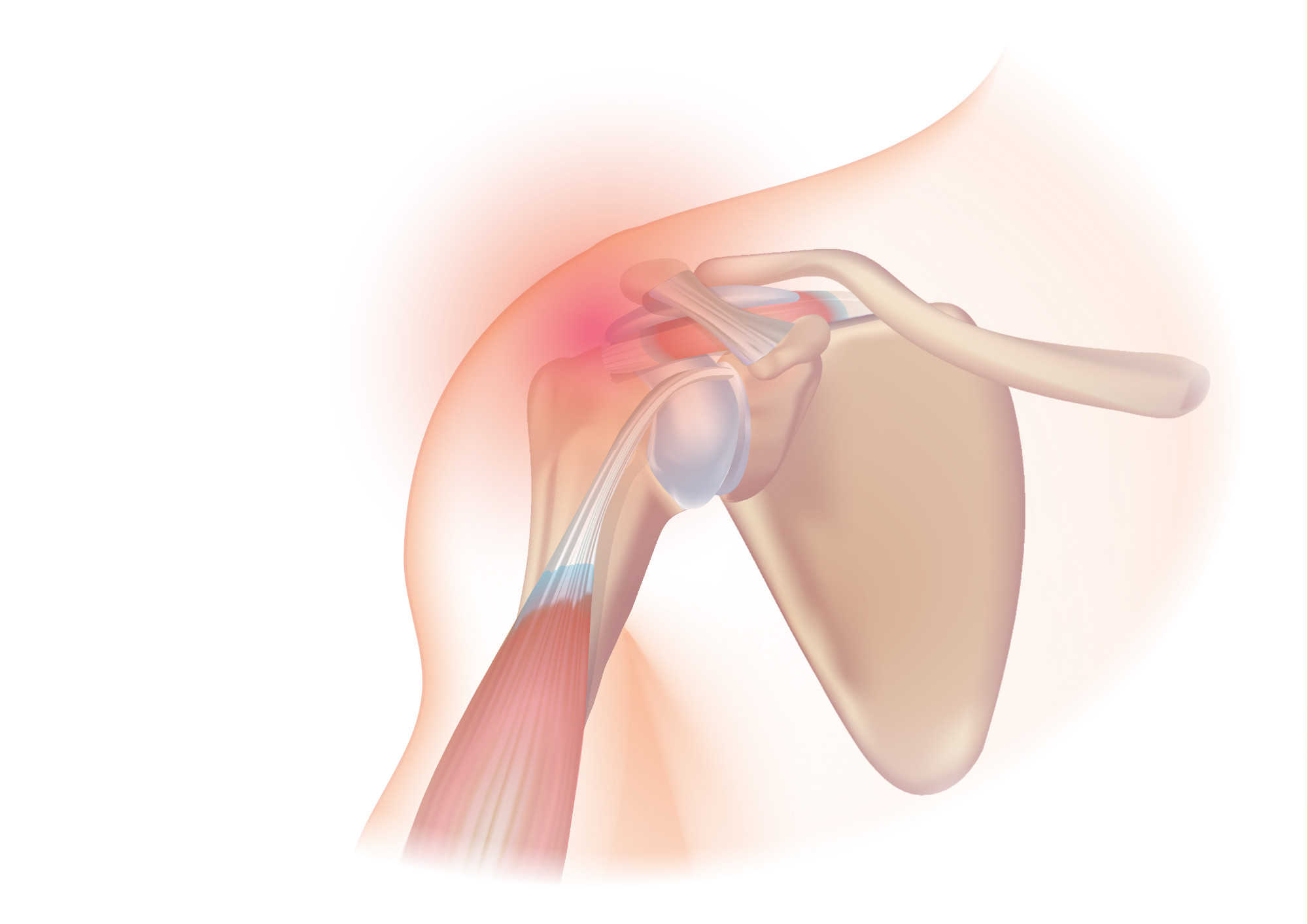
Location where the rotator cuff tendon wraps around the humeral head and passes beneath the acromion. Source: Injurymap · CC BY 4.0 · used as original

How is this different from a rotator cuff tear, frozen shoulder, or calcific tendinitis?
It's important to distinguish between pain when lifting the arm and an actual loss of strength. Along with checking which angle causes pain, tests should measure strength when holding the arm up and rotating it outward.
A rotator cuff tear causes weakness when lifting the arm or rotating it outward. A clue is difficulty lifting objects you previously handled with ease, or trouble holding the arm in a raised position; partial tears may retain some strength, so ultrasound is used to confirm them.
If you fell or felt a sudden loss of strength after lifting something heavy, the first step is to rule out a tear, and if a tear is found, the next step is determining whether surgical repair is needed.
With frozen shoulder, range of motion is limited even when someone else moves your arm for you. Both active motion (moving it yourself) and passive motion (someone else moving it) are reduced together, and outward rotation in particular becomes restricted, making it increasingly difficult to get dressed or reach behind your back.
With shoulder impingement syndrome, even if raising the arm yourself is painful, passive range of motion (when someone else supports and moves the arm) is generally preserved. If passive range of motion is also limited, this suggests joint stiffness; if the arm can move but strength is reduced, ultrasound helps confirm whether a tear is present and whether repair is needed. This distinction, combined with strength testing and ultrasound findings, helps differentiate between the conditions.
Calcific tendinitis involves calcium deposits building up in the tendon. In the acute phase, pain can be severe even at night, and lifting the arm can become difficult within just a few days. These four conditions can overlap. For example, calcium deposits or a partial tear may coexist with subacromial impingement, or prolonged disuse of the shoulder may lead to accompanying joint stiffness.
Ansim Teunteun Pain Clinic performs ultrasound diagnosis while the patient moves their arm. Without radiation exposure, this allows real-time observation of the moment the tendon passes beneath the acromion, capturing the exact posture where impingement occurs along with bursal swelling, tendon thickness, and partial tears, and connects these findings to the movements and strength tests that reproduce the pain (Lambers Heerspink FO et al., 2026).
X-rays are used to assess the shape of the acromion and check for calcium deposits, and if acute pain began after trauma, they also help check for fracture (Laur O et al., 2025).
How is this treated?
Treatment focuses on reducing pain while restoring shoulder blade movement and rotator cuff function. Rehabilitation therapy is also used to help the shoulder blade move properly in coordination with the arm.
First, ultrasound-guided injections deliver medication precisely to the area around the bursa or tendon under direct visualization, helping calm inflammation and pain. If tendinitis or calcium deposits are present, focused or radial extracorporeal shock wave therapy may be used; if the tendon is wearing down toward a partial tear, PRP (platelet-rich plasma, made from the patient's own blood) or PDRN injections may help stimulate a healing response; and if tendon damage is longstanding and pain keeps returning despite repeated injections, autologous blood-based regenerative treatment may be used to concentrate regenerative cells and growth factors and deliver them to the damaged area. Once the arm can move more freely, treatment shifts to restoring motion and strength. Manual therapy helps release a rounded-shoulder posture and stiffness around the shoulder blade, while rehabilitation therapy works to restore the shoulder blade's rotational rhythm with the arm and rebuild rotator cuff strength. If muscle trigger points are also present, trigger point injection (TPI) may be added, and if pain remains concentrated in one spot for a long time, nerve block procedures may help.
When pain is too severe to begin exercise, clinical guidelines also recommend using injections first to reduce pain before starting movement-based therapy (Lambers Heerspink FO et al., 2026). Once the arm can tolerate more movement, treatment focuses on restoring shoulder motion and strength within a tolerable range.
If daily function remains limited despite conservative treatment, or if a tear requiring surgical repair is confirmed, surgery may be discussed. However, subacromial decompression surgery, which widens the space beneath the acromion, has not been shown to offer clear additional benefit over conservative treatment for subacromial pain lasting more than 3 months (Lähdeoja T et al., 2020), and it serves a different purpose than surgery to repair a torn tendon.
What happens if this is left untreated?
If the repetitive strain that triggers the pain continues, irritation of the bursa and tendon may persist, and it's also important to check whether tendon degeneration or a partial tear is present. Avoiding use of the shoulder for a long time because of pain can lead to joint stiffness and overlapping frozen shoulder, at which point not just pain but also the range of arm movement becomes limited.
After treatment, it's worth checking how much easier it has become to raise the arm and lie down at night, and whether range of motion and strength are recovering.
If the catching pain at a specific angle continues for more than 2 weeks, if pain wakes you up at night, or if getting dressed or washing your hair becomes more difficult, it's time to see a doctor.
If the shoulder becomes swollen and warm along with fever, or if the shape of the shoulder changes after an injury, seek medical care the same day regardless of how long symptoms have lasted.
References
- Horowitz EH, Aibinder WR (2023). Shoulder Impingement Syndrome.. Phys Med Rehabil Clin N Am. PMID: 37003655
- Lambers Heerspink FO, Veen EJD, Dorrestijn O (2026). Update of guideline for diagnosis and treatment of subacromial pain syndrome: a multidisciplinary review by the Dutch Orthopedic Association Part 1: preventive measures, diagnostics, and non-surgical treatment of subacromial pain syndrome.. Acta Orthop. PMID: 41718640
- Laur O, Ha AS, Bartolotta RJ (2025). ACR Appropriateness Criteria® Acute Shoulder Pain: 2024 Update.. J Am Coll Radiol. PMID: 40409888
- Lähdeoja T, Karjalainen T, Jokihaara J (2020). Subacromial decompression surgery for adults with shoulder pain: a systematic review with meta-analysis.. Br J Sports Med. PMID: 30647053
Frequently Asked Questions
Q. Is it okay to test the painful angle at home by repeatedly raising my arm?
There's no need to deliberately repeat the motion that causes pain to check the angle. Forcing your arm past the painful range, or having someone else force it upward, can further irritate the bursa and tendon, so this should be avoided.
Q. Should I bring previous imaging and injection records to a shoulder pain appointment?
If you have prior imaging, radiology reports, or records noting the date, location, and medication of past injections, bringing them can be helpful. Comparing past results with the current exam findings, and knowing how much and how long pain relief lasted after previous injections, helps guide the next treatment decision.
Q. How should I adjust overhead work and exercise while I have pain?
For overhead tasks that trigger pain, try reducing the height, repetition, and weight involved, and take breaks in between. Rather than avoiding shoulder movement entirely, move within a range that doesn't worsen the pain, and reduce activity if pain lingers afterward or is worse the next day.
Q. Should I continue scheduled rehabilitation visits even if pain improves after an injection?
Even if pain decreases, rehabilitation should continue to confirm that shoulder blade movement and strength have sufficiently recovered. After checking range of motion and strength, the treatment interval and exercise load can be adjusted, and lifting heavier objects or overhead exercise can be increased gradually.