
Last updated: 2026-11-12
Only the Front of My Shoulder Still Hurts When I Reach Out My Arm
If the front of your shoulder keeps hurting when you reach your arm forward or lift something, even after getting a shoulder injection, you should suspect biceps tendinitis. The long head of the biceps tendon, the long tendon of the biceps muscle at the front of the upper arm, runs through the groove at the front of the shoulder, and biceps tendinitis is inflammation of this tendon and of the tendon sheath that surrounds it at that spot.
For example, an office worker in their 50s may come in after feeling a sharp twinge in the front of the shoulder while moving a pack of bottled water into a cart at the supermarket or taking a box down from a shelf. After an earlier shoulder injection, the catching pain they used to feel when lifting the arm out to the side had eased. But when they reach the arm forward or lift something heavy, the pain in one spot at the front of the shoulder remains just as it was.
Pain like this remains because, when a shoulder injection is given, the anatomical site where the medication goes differs depending on the underlying condition. For shoulder impingement syndrome and rotator cuff tendon problems, the injection goes into the subacromial space, the space below the acromion at the tip of the shoulder blade. For biceps tendinitis, the medication needs to go into the biceps tendon sheath in the groove at the front of the shoulder. On top of that, biceps tendinitis often occurs together with rotator cuff tendon problems or shoulder impingement syndrome in the same shoulder. So even when inflammation in the subacromial space settles down and the pain from lifting the arm sideways decreases, the front shoulder pain can remain because of the biceps tendinitis that was present alongside it.
At Ansim Teunteun Pain Clinic, we use ultrasound diagnosis to directly check whether the biceps tendon and tendon sheath in the groove at the front of the shoulder are swollen, and the doctor gives an ultrasound-guided injection into the biceps tendon sheath while watching it on ultrasound.
Why Does Biceps Tendinitis Cause Pain in the Front of the Shoulder?
The biceps is the muscle that forms the bulge on the front of the upper arm. Its upper end divides into two tendons, a short one and a long one. The long one, the long head of the biceps tendon, runs upward along the intertubercular groove, a narrow channel on the front of the humerus, and enters the shoulder joint. Inside this narrow groove, a thin membrane called the tendon sheath wraps around the biceps tendon and protects it.
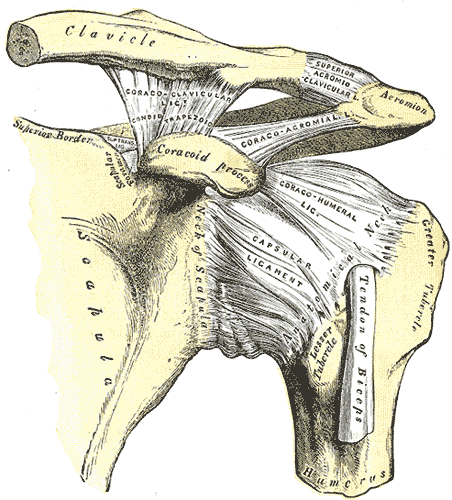 Anterior anatomical view of the shoulder. The long head of the biceps tendon runs along the groove between the greater and lesser tubercles on the front of the humerus, with the acromion and coracoid process above (Henry Vandyke Carter, Public domain)
Every time you reach your arm forward or bend your elbow to lift something, the biceps tendon pulls taut and slides up and down within the groove on the front of the humerus. Repeating these movements for long periods, whether in daily life or at work, makes the biceps tendon and its sheath rub against the walls of the groove, so they swell and become inflamed. Once biceps tendinitis begins this way, it mainly causes pain in the front of the shoulder. Pressing directly on the groove at the front of the shoulder with a finger produces distinct pain, and that pain can also travel down along the muscle on the front of the upper arm.
Tension builds in the biceps tendon when you raise your arm forward with the elbow straight while resisting a downward push, and when you turn your palm up toward the sky with the elbow bent at a right angle. That is why these movements make the pain in the front of the shoulder even worse.
The long head of the biceps tendon also moves right alongside the rotator cuff tendons inside the shoulder joint, so the two structures affect each other. A U.S. study that analyzed the MRI reports of 406 adult patients who had MRI scans for shoulder pain found that people with abnormalities in the rotator cuff tendons were about seven times more likely to also have abnormalities in the biceps tendon (Canavan K et al., 2025). In the same study, among 175 shoulders with confirmed biceps tendon abnormalities, only 9 (5%) had a completely normal supraspinatus tendon, which is one of the rotator cuff tendons, and biceps tendon abnormalities were observed about 4% more often with each additional year of age.
Unlike Rotator Cuff Problems and Impingement Syndrome, It Hurts in a Different Spot
Shoulder impingement syndrome is characterized by pain on the outer side of the shoulder, as if something is catching, when the arm passes a specific angle near shoulder height while being raised to the side. When the rotator cuff tendon is affected, pain spreads widely from the outer shoulder to the outer upper arm, and it gets worse at night when lying on the painful shoulder. If the tendon tears, the strength to lift the arm also weakens. Biceps tendinitis, by contrast, hurts directly over the groove at the front of the shoulder, and it hurts more when reaching the arm forward, lifting objects, and turning the palm upward.
When these three conditions occur together in the same shoulder, however, the painful areas and the uncomfortable movements overlap. This makes it difficult to tell which structure is the main source of pain from a physical exam alone, in which the doctor presses on the shoulder and moves the arm. In fact, a Japanese research team that studied 30 patients with biceps tendinitis reported that the spot patients pointed to with a finger as painful at the front of the shoulder did not always match the actual anatomical location of the inflammation.
An analysis pooling 7 studies (448 patients) that identified biceps tendon disease with physical examination and ultrasound also found that manual physical examination was reliable for only one of two roles, either confirming that biceps tendon disease is present or ruling it out.(Courage O et al., 2023) Ultrasound, in contrast, produced reliable results both for confirming that biceps tendon disease is actually present and for ruling it out. However, a retrospective analysis of 300 biceps tendon sheath injections found that the biceps tendon looked normal in shape on pre-procedure ultrasound in 43% of cases, so the changes in shape on the ultrasound screen need to be matched with tenderness at the front of the shoulder and pain during movement.(PMID 31187487)
At Ansim Teunteun Pain Clinic, we use ultrasound diagnosis to check whether the biceps tendon has thickened and whether fluid (effusion) has collected inside the tendon sheath, and at the same time we check whether there are also abnormalities in the rotator cuff tendons and the space under the shoulder blade. When we diagnose with ultrasound, we do not only scan in a fixed position; we can examine the arm while actually moving it. So the doctor rotates the patient's arm inward and outward and checks in real time whether the biceps tendon is unstable and slips out of the groove at the front of the humerus. This exam involves no radiation exposure, takes about 10 to 15 minutes, and is covered by national health insurance, and during the exam you can watch the ultrasound together with the doctor and hear an explanation of the tendon's condition right away.
If a 'Pop' Sound Is Followed by a Bulge in the Front of the Upper Arm
If you hear a "pop" at the front of the shoulder while lifting a heavy object, and the muscle at the front of the upper arm then bunches up near the elbow into a round bulge, the long head of the biceps tendon may have completely ruptured. In this case, before giving an injection to calm the inflammation, we first check with ultrasound whether the tendon is intact and still continuous within the groove of the humerus.
If you cannot lift your arm on your own after a sudden fall or a hard blow to the shoulder, the first thing to check is whether the rotator cuff tendon has torn extensively. Also, if the skin at the front of the shoulder becomes red and swollen without any injury, and it feels hot to the touch or you have a fever, it must first be determined whether this is an infection of the joint or the surrounding tissue rather than ordinary tendon inflammation.
If turning your head to the side or backward causes pain and a tingling sensation that travels down past the shoulder into the arm and fingertips, you need to be checked for a pinched nerve coming from the cervical spine. In particular, if your left shoulder hurts and you also feel tightness in the chest or shortness of breath, this may be referred pain from a heart condition. You should therefore seek emergency care without delay.
Ultrasound-Guided Injections into the Tendon Sheath: How Many Will I Need?
At Ansim Teunteun Pain Clinic, we use ultrasound-guided injections to treat biceps tendinitis. The biceps tendon sheath lies deep inside a narrow groove on the front of the humerus. Because of this, it is hard to know whether the needle tip has properly entered the tendon sheath by feeling the skin with the hand alone. On ultrasound, by contrast, the round cross-section of the biceps tendon, the sheath surrounding it, and the position of the advancing needle tip can all be seen together at a glance.
In a Japanese study that randomly divided 30 patients with biceps tendinitis, gave injections mixed with a contrast agent, and checked the result with CT, 86.7% of ultrasound-guided injections went precisely into the biceps tendon sheath alone.(Hashiuchi T et al., 2011) By comparison, only 26.7% of palpation-guided injections went into the tendon sheath, and 33.3% failed to enter the sheath and spread only into the surrounding tissue. In a Greek study comparing 44 patients with long head of the biceps tendinopathy, ultrasound-guided injections also took less time to perform and caused less pain during the procedure than palpation-guided injections. Pain and shoulder function scores evaluated 4 weeks and 6 months after the injection also improved more in the ultrasound-guided group.(Yiannakopoulos CK et al., 2020)
A Chinese study comparing 98 patients with biceps tendinitis likewise found that in the ultrasound-guided injection group, the average pain score on a 10-point scale dropped from 6.9 before the procedure to 2.1, while in the palpation-guided group it fell from 7.1 to 4.2.(Zhang J et al., 2011) However, in the same study, when arthroscopy confirmed that the biceps tendon itself was badly frayed, injection treatment alone did not produce a satisfactory outcome.
The doctor applies examination gel to the front of the patient's shoulder, locates the biceps tendon and its sheath with an ultrasound probe, disinfects the skin, and then, while watching the ultrasound, inserts a thin needle to inject medication into the tendon sheath and applies an adhesive bandage. The procedure takes about 5 to 10 minutes. Ultrasound-guided injection is partially covered by national health insurance and is usually given 1 to 3 times at 1- to 2-week intervals. A single injection sometimes relieves the pain sufficiently, but depending on the degree of inflammation around the tendon, 2 to 3 injections may be needed. So we check how much the pain has eased each time and continue with the next treatment accordingly. If the ultrasound diagnosis also reveals an abnormality in the rotator cuff tendons or the subacromial space, the doctor treats that area as well while watching the ultrasound.
After the injection, the needle site may feel temporarily stiff or become slightly swollen and bruised, but in most cases this settles on its own within 1 to 2 days. For 1 to 2 days after the procedure, you should rest the shoulder and avoid straining it. A light shower is fine, but you should avoid public baths, saunas, and swimming pools for 1 to 2 days. In rare cases, if the injection site turns red, feels warm, and the pain gets worse day by day, you should contact the clinic to have it checked.
At Ansim Teunteun Pain Clinic, we do not stop at reducing the immediate pain; we continue treatment through the process of restoring the shoulder's movement and strength. If tendon pain at the front of the shoulder lingers for a long time even after the injection has calmed the acute inflammatory pain, we perform extracorporeal shockwave therapy 3 to 5 times at 1-week intervals. Once the sharp pain eases, we use one-on-one rehabilitation therapy to restore the range of motion of the stiffened shoulder joint and to build up the surrounding muscle strength that holds the shoulder blade and the humerus in place. Even after the pain has settled, it takes several weeks for the tendon to regain stability. During that time, cutting back on movements that involve reaching the arm straight out to lift heavy objects, and increasing the weight you lift little by little in stages during rehabilitation, helps prevent recurrence.
Jinyeol Kwon · Anesthesiology and Pain Medicine Specialist · Ansim Teunteun Pain Clinic
References
- Canavan K, Zai Q, Bruni D, Alexander J, Oude Nijhuis KD, Ring D (2025). Long Head of Biceps Tendinopathy Is Associated With Age and Cuff Tendinopathy on MRI Obtained for Evaluation of Shoulder Pain.. Clin Orthop Relat Res. PMID: 39679662
- Courage O, van Rooij F, Saffarini M (2023). Ultrasound is more reliable than clinical tests to both confirm and rule out pathologies of the long head of the biceps: a systematic review and meta-analysis.. Knee Surg Sports Traumatol Arthrosc. PMID: 36114842
- Geannette C, Williams D, Berkowitz J, Miller TT (2019). Ultrasound-Guided Biceps Tendon Sheath Injection: Spectrum of Preprocedure Appearances.. J Ultrasound Med. PMID: 31187487
- Hashiuchi T, Sakurai G, Morimoto M, Komei T, Takakura Y, Tanaka Y (2011). Accuracy of the biceps tendon sheath injection: ultrasound-guided or unguided injection? A randomized controlled trial.. J Shoulder Elbow Surg. PMID: 21782470
- Yiannakopoulos CK, Megaloikonomos PD, Foufa K, Gliatis J (2020). Ultrasound-guided versus palpation-guided corticosteroid injections for tendinosis of the long head of the biceps: A randomized comparative study.. Skeletal Radiol. PMID: 31712838
- Zhang J, Ebraheim N, Lause GE (2011). Ultrasound-guided injection for the biceps brachii tendinitis: results and experience.. Ultrasound Med Biol. PMID: 21458143
Frequently Asked Questions
Q. What records should I prepare if I received a shoulder injection elsewhere?
Having a record of the date and site of the previous injection and the name of the medication used helps distinguish the course of treatment. Separately noting which movements became easier after the injection and which ones still hurt also serves as a useful reference for finding the cause of the remaining pain.
Q. If biceps tendinitis and rotator cuff problems occur together, how is the treatment order decided?
At Ansim Teunteun Pain Clinic, we decide the treatment order by asking about the movements that trigger the pain, examining the tender spots, and checking for tendon damage with ultrasound. After determining whether there is a problem that needs to be evaluated first, such as a tear, we choose which area to treat based on the pain that most limits daily movement and on any accompanying conditions.
Q. If pain decreases after the injection, can I start lifting objects and doing rehabilitation exercises right away?
Even if the pain has decreased, rather than going straight back to repeatedly lifting objects at the previous weight, resume activity in line with the activity restrictions you were given after the injection and whether the tendon is damaged. Start rehabilitation exercises within the set range, and adjust the weight of objects and the number of repetitions according to the pain you feel during the movement and any discomfort the next day.