Last updated: 2026-10-08
It Hurts as If Rubbed Where the Back of My Shoe Touches My Heel Bone
If the spot just above your heel bone feels rubbed and sore when the back of your shoe touches it, it's worth knowing about insertional Achilles tendinitis, which is pain at the spot where the Achilles tendon attaches to the bone. Many people go through the same thing again and again: on days they wear dress shoes or sneakers with a stiff heel counter, the back of the heel rubs and hurts where the shoe touches it, and taking the shoes off brings noticeable relief. In many cases, this discomfort is not simple skin friction but starts at the site where the Achilles tendon attaches firmly to the heel bone.
Insertional Achilles tendinitis is a condition in which inflammation, pain, and tenderness concentrate at the point where the Achilles tendon attaches to the heel bone. When the pain becomes severe, the area around the bony prominence swells, and even the touch of a shoe becomes a major source of irritation. When people think of Achilles tendon problems, they usually picture midportion Achilles tendinitis first, in which the middle of the tendon, roughly 2 to 6 cm above the heel bone, swells and hurts. In insertional disease, however, the lesion is confined to the interface between bone and tendon, so its location and presentation are clearly different (de Vos RJ et al., 2021).
Looking at the structures around the insertion, a Haglund's deformity, in which the back upper edge of the heel bone bulges outward, is often seen. Between this bony prominence and the Achilles tendon sits a small fluid-filled sac called a bursa, which reduces friction (Chimenti RL et al., 2017). When a stiff shoe heel presses in from outside on a heel bone that already protrudes, the tendon and bursa are squeezed from both sides, and the pain and inflammation become even worse.
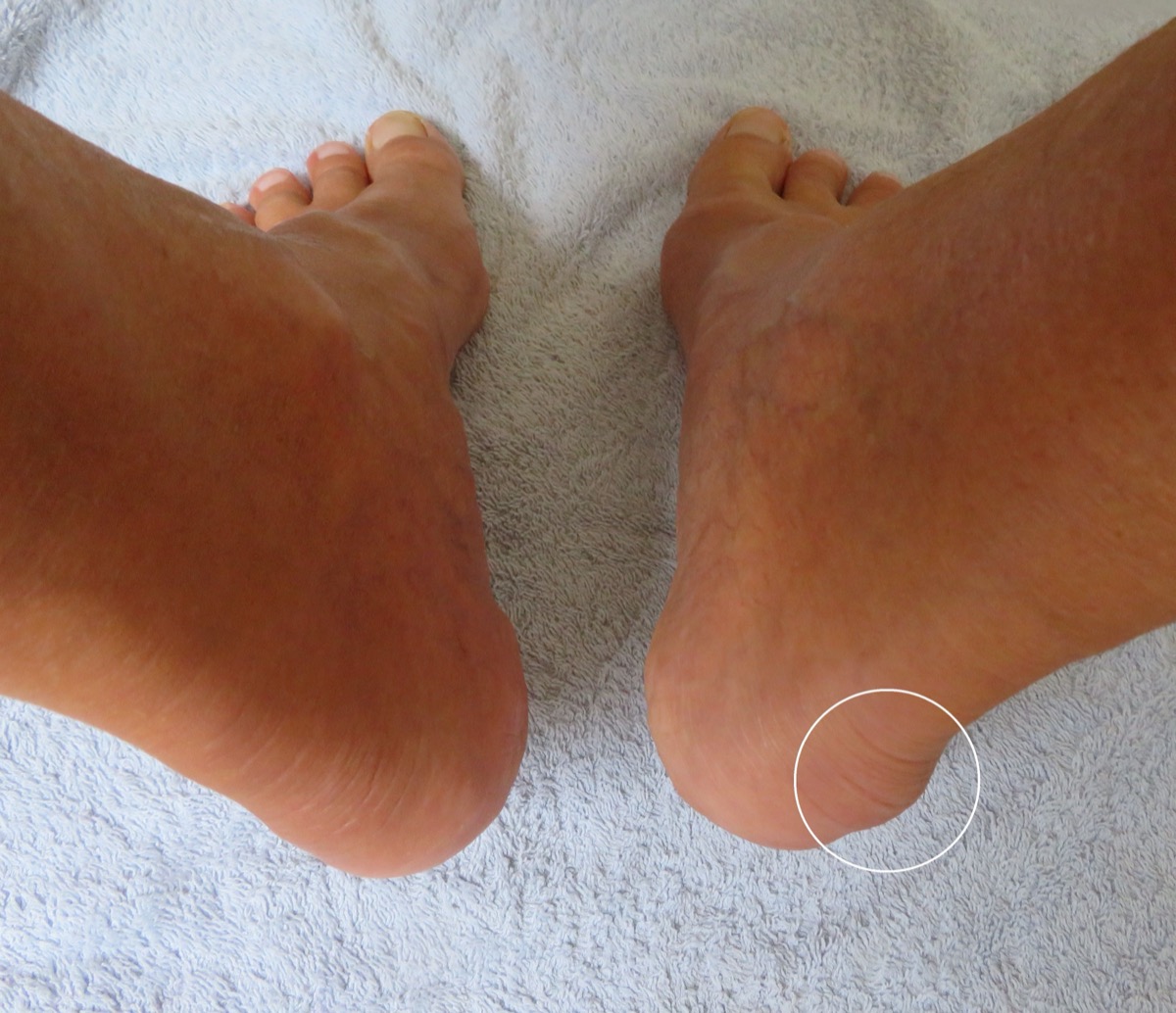 The spot where the back upper edge of the heel bone protrudes (circled), compared with the opposite heel (Sciencia58, CC0, Wikimedia Commons)
Where Does the Tendon Get Pressed on Stairs and Uphill Slopes?
Some people find walking on flat ground bearable but feel a distinct stiffness and pulling behind the heel when they climb stairs or walk up a steep hill. Climbing stairs or an uphill slope, or squatting down deeply, bends the ankle sharply upward. When the ankle bends this way, the Achilles tendon is pulled hard upward under tension and, at the same time, wraps tightly around the bony prominence at the back of the heel bone, so it is also squeezed against the bone by compressive force (Cook JL et al., 2012).
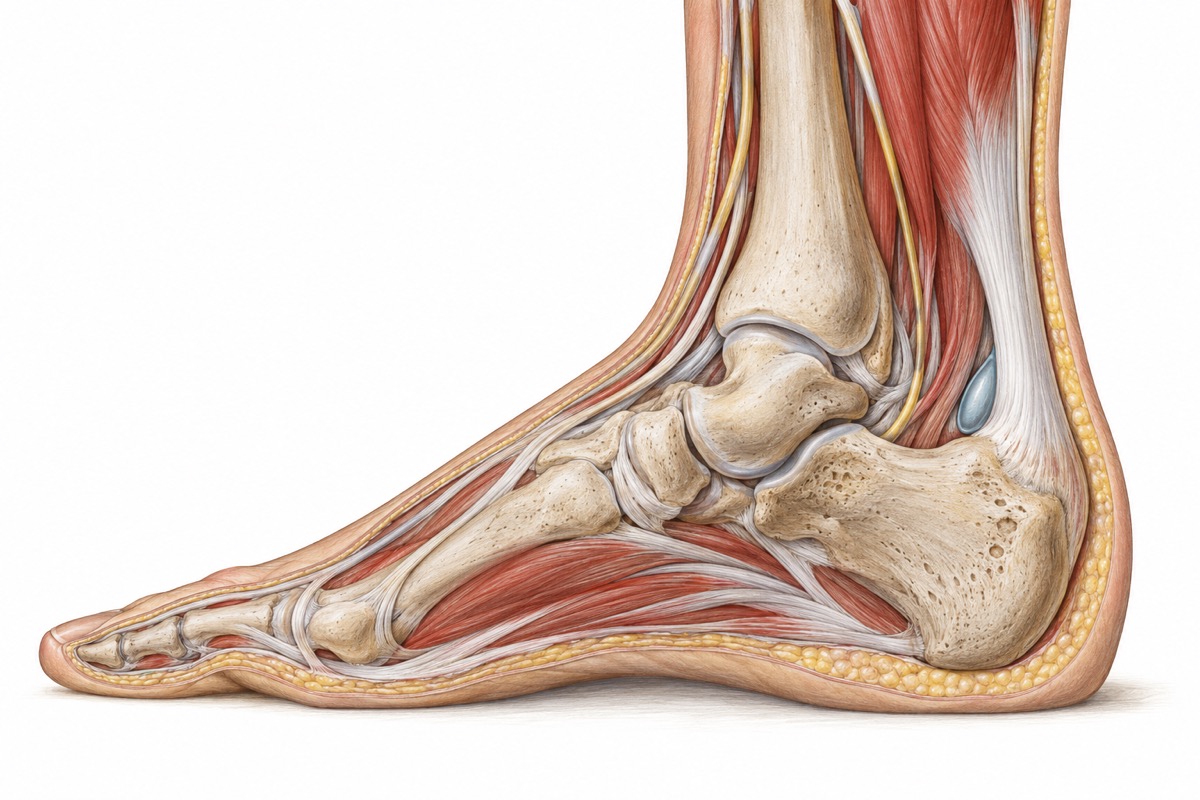 A side-view cross-section of where the Achilles tendon attaches to the back of the heel bone, with the bursa just in front of it (AI-generated illustration)
A study that analyzed how patients with insertional Achilles tendinitis walk up stairs observed a distinctive movement pattern. Because of an unconscious compensatory response to avoid pain, their ankles bent upward more deeply, while the force of the calf muscles that push the ankle downward was markedly reduced (Chimenti RL et al., 2017). When you go up and down stairs in daily life, the calf cannot use its full strength and the load shifts toward the insertion, so the symptoms get worse.
As a result, stiff pain appears when you take your first steps after getting up in the morning or start moving suddenly after a rest. As you keep going or after you finish exercising, the pain and local warmth become steadily more noticeable (de Vos RJ et al., 2021).
Three Things We Check on a Heel Ultrasound
When you visit us with pain at the insertion, we carefully ask how long the symptoms have lasted and which particular shoes or movements bring on the pain, then press directly on the painful spot with a finger to pinpoint where the tenderness is. Next, we perform an ultrasound exam to look closely at changes inside the tendon and in the surrounding tissue. Ultrasound is a real-time exam with no radiation exposure at all. While you bend or rotate your ankle, the doctor and you can see structural problems right away, and the exam takes about 10 to 15 minutes.
On ultrasound, we first focus on the thickness of the tendon at the insertion and the condition of its fiber pattern. A normal tendon has a uniform, bright appearance, while a damaged area looks darker (hypoechoic) and its fiber pattern is disrupted. Clinical studies regard thickening of the tendon at the insertion beyond 6 mm as a key pathological criterion (Chimenti RL et al., 2017). Second, we check whether the bursa between the Achilles tendon and the heel bone has filled with fluid and whether inflammation has spread. Third, we check for calcium deposits inside the tendon and for bone spurs that have grown into sharp points at the edge of the bone (de Vos RJ et al., 2021).
If the insertions on both heels swell at the same time and your lower back is severely stiff every morning, spondyloarthritis such as ankylosing spondylitis needs to be evaluated. If red swelling also appears around the big toe joint, we check whether it is gout caused by uric acid buildup. If you hear a popping sound from the heel, as if something has snapped, while walking or exercising and then find it hard to stand on tiptoe, we check for an Achilles tendon rupture without delay.
How Are Extracorporeal Shockwave Therapy and PRP Autologous Blood Injections Each Performed?
We combine the examination findings with what the ultrasound showed, namely tendon thickness, the degree of bursal inflammation, and whether calcification has formed, to set up a treatment plan. We widely use extracorporeal shockwave therapy to help the tissue at the insertion regenerate and to promote blood circulation. Extracorporeal shockwave therapy delivers physical energy generated outside the body to the damaged insertion. We apply focused and radial shockwaves flexibly according to the depth and size of the lesion. Focused shockwaves concentrate energy on a single point to stimulate the deep tendon interface, while radial shockwaves spread energy over a wider area to loosen the superficial tissue and the surrounding fascia. Each session takes about 10 minutes, and treatment is usually given 3 to 5 times at 1-week intervals. Strenuous exercise should be avoided for a day or two after a session, and the treated area may turn red for a while or show slight swelling that lingers for a few days.
In a randomized controlled trial of 50 patients whose insertional pain had become chronic, lasting 6 months or more, the eccentric exercise group's pain score at the 4-month follow-up fell only slightly, from 7 to 5, while the extracorporeal shockwave therapy group's score fell markedly, from 7 to 3 (Rompe JD et al., 2008). A systematic review of 23 studies also reported clear treatment effects when extracorporeal shockwave therapy was used alone or together with exercise therapy for chronic insertional tendinopathy (Zhi X et al., 2021).
When the tendon damage is long-standing or the tissue's capacity to recover has declined, we use PRP (platelet-rich plasma) autologous blood injections. We draw 20 to 40 ml of blood from your arm, spin it in a centrifuge to extract autologous plasma with a high concentration of platelets, and inject it precisely into the painful part of the tendon. The procedure takes about 30 minutes and is performed 1 to 3 times at intervals of 2 to 4 weeks. It takes roughly 2 to 3 weeks for the growth factors in the injected platelets to act on the damaged tissue and start a healing response. For this reason, we recheck how the tendon fibers are recovering with ultrasound at weeks 4 to 6 and decide on the follow-up schedule. Local soreness and swelling may appear for 2 to 3 days after the injection, so vigorous movement should be avoided for 3 to 4 days, and from 2 weeks on you gradually widen the range of your daily activities. As a supplementary option, we sometimes use DNA injections, which help microscopic damage recover, 3 to 5 times at 1- to 2-week intervals, and for chronic damage that has been slow to improve with existing treatment, we consider autologous blood regenerative therapy, which uses the SMART M-CELL system to separate concentrated autologous cells for injection, within a range of 1 to 3 sessions.
When Calf Exercises Make Your Heel Hurt More
Quite a few patients with insertional Achilles tendinitis say that their heel actually began to hurt more after they started calf-strengthening exercises. The classic eccentric exercise has you rest only the front of your foot on the edge of a step and, while tightening your calf, lower your heel deep below the level of the step. This exercise helps midportion tendinitis, but it is too demanding for insertional tendinitis. For insertional disease, a modified version should be used instead: on flat ground rather than a step edge, you lower your heel only to the neutral position so that your ankle does not bend past it.
According to a preliminary clinical study, when the conventional exercise of lowering the heel deep below a step was given to patients with insertional tendinitis, only 32% had good results, but in a group that did a modified eccentric exercise for 12 weeks, with the ankle's bend limited to flat-ground level, 67% of 27 patients reported satisfactory improvement and a return to daily activities at an average follow-up of 4 months (Jonsson P et al., 2008). A randomized clinical trial of 42 athletes also found that a rehabilitation group that strictly excluded stretches bending the ankle deeply upward and used heel-raise pads to minimize tendon compression improved on the VISA-A pain and function score by 24.4 points at week 12 and 29.0 points at week 24, a better recovery than the comparison group's 12.2 and 19.3 points (Pringels L et al., 2025).
In daily life, too, activities that put strong compression on the tendon, such as running, hiking, and walking uphill, should be strictly reduced to a pain-free level, and the exercise load should be raised step by step in line with how fast you recover. Wearing shoes with a soft heel counter or a slightly raised heel of about 2 to 3 cm, or using heel-raise pads, helps ease the tension and compression that press the tendon against the bone (Chimenti RL et al., 2017). If you also receive rehabilitation therapy, in which a therapist applies joint mobilization and muscle energy techniques by hand one-on-one for 30 to 40 minutes per session, the stiff ankle joint and tense calf muscles loosen up and joint alignment becomes more stable.
Jinyeol Kwon · Anesthesiology and Pain Medicine Specialist · Ansim Teunteun Pain Clinic
References
- de Vos RJ, van der Vlist AC, Winters M (2021). Dutch multidisciplinary guideline on Achilles tendinopathy.. Br J Sports Med. PMID: 34187784
- Chimenti RL, Cychosz CC, Hall MM (2017). Current Concepts Review Update: Insertional Achilles Tendinopathy.. Foot Ankle Int. PMID: 28789557
- Cook JL, Purdam C (2012). Is compressive load a factor in the development of tendinopathy?. Br J Sports Med. PMID: 22113234
- Rompe JD, Furia J, Maffulli N (2008). Eccentric loading compared with shock wave treatment for chronic insertional achilles tendinopathy. A randomized, controlled trial.. J Bone Joint Surg Am. PMID: 18171957
- Zhi X, Liu X, Han J (2021). Nonoperative treatment of insertional Achilles tendinopathy: a systematic review.. J Orthop Surg Res. PMID: 33785026
- Jonsson P, Alfredson H, Sunding K (2008). New regimen for eccentric calf-muscle training in patients with chronic insertional Achilles tendinopathy: results of a pilot study.. Br J Sports Med. PMID: 18184750
- Pringels L, Capelleman R, Van den Abeele A (2025). Effectiveness of reducing tendon compression in the rehabilitation of insertional Achilles tendinopathy: a randomised clinical trial.. Br J Sports Med. PMID: 40011018
Frequently Asked Questions
Q. Can insertional Achilles tendinitis develop even if I don't exercise much?
Even if you don't exercise much, a sudden increase in the time you spend standing or walking in daily life can build up strain on the insertion. If you keep a record not only of how much you have exercised recently but also of your commuting distance, how long you stand at work, and when you changed shoes, it helps you find what is triggering the pain.
Q. If my heel bone sticks out, is it Haglund's deformity?
A bump at the back of the heel can come not only from a change in the shape of the bone but also from a thickened tendon or swelling of the surrounding tissue. Haglund's deformity is a shape in which the upper back part of the heel bone protrudes, and if needed, we check its location and shape with a side-view X-ray. A protruding bone does not always cause pain, so we tell them apart by also checking where the tenderness is.
Q. How much can I walk to and from work while receiving extracorporeal shockwave therapy or PRP treatment?
How much you walk for your commute is decided according to the type of procedure and how badly the tendon is damaged, and right after a PRP injection in particular, the weight-bearing restrictions you were given come first. If walking is allowed, walk short distances on flat ground, and if you start limping or the pain the next morning is worse than usual, shorten the distance you walk and take transportation instead.