
Last updated: 2026-09-18
Do You Really Need Surgery for Bunions (Hallux Valgus)?
If your big toe is turning inward and the widened forefoot makes shoes feel tight, you may be dealing with a bunion, medically known as hallux valgus. Having the deformity alone doesn't mean surgery follows automatically. If the front of your foot feels stiff, or a shoe that used to fit comfortably now rubs specifically against the inside of your big toe, take time to review both the structure of the deformity and the symptoms showing up right now.
Hallux valgus develops when the big toe tilts toward the second toe while the first metatarsal bone behind it drifts toward the inside of the foot. Because the first metatarsal and the big toe bone angle in opposite directions, the joint at the base of the big toe pushes outward, creating a bump. This spot rubs repeatedly against the inner leather or seam of a shoe, causing the skin to redden, the bursa (a small fluid-filled sac that cushions the joint) to become inflamed, and calluses or blisters to form again and again.
This kind of foot change is very common among middle-aged and older women. A systematic review and meta-analysis of the general population found that the prevalence of hallux valgus was about 23% among adults aged 18 to 65, rising to 35.7% in those 65 and older, and notably higher in women than in men (Nix Sheree et al., 2010). As people age, the elasticity of the sole and ligaments decreases, and finding comfortable shoes tends to become harder in the 50s and 60s, which is closely tied to this structural change. Because of this, a change in bone angle alone isn't a reason to rush into surgery. Conservative treatment aimed at reducing pain and making walking more comfortable typically comes first, while the condition of the foot is monitored.
How Is the Degree of Deviation Measured?
To track how far a big toe deformity has progressed, it helps to separate two things: the visible changes you can record at home, and the angle measured on X-ray in the clinic. At home, you can place paper on the floor, stand with weight evenly distributed, and take photos of both feet from the same overhead angle periodically to compare over time.
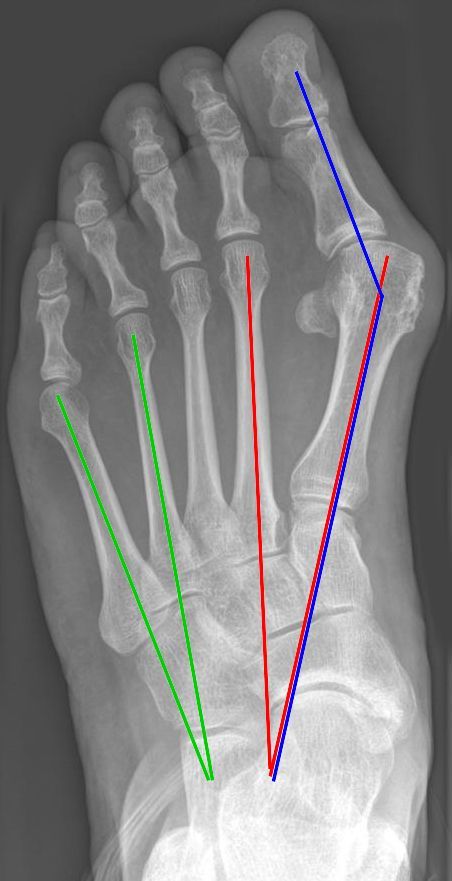 Weight-bearing foot X-ray. The angle between the blue line drawn along the big toe bone and the red line drawn along the first metatarsal is the hallux valgus angle, and the angle between the red line and the second metatarsal line shows how much the forefoot has widened. Public educational material. (Jmarchn from Hellerhoff work, CC BY-SA 3.0)
A standard tool for assessing visible appearance is the Manchester scale, which grades deformity by comparing your own foot shape against four standard photographs showing progressively worse stages. In a study evaluating the Manchester scale in 95 older adults aged 62 to 94, this photographic grading correlated significantly with the degree of deformity measured on actual X-ray images (Menz H B et al., 2005). Even so, it remains a tool for gauging visible stages only.
Accurate assessment relies on a weight-bearing foot X-ray taken in the clinic (Ettinger Sarah et al., 2025). The X-ray measures the hallux valgus angle between the big toe bone and the first metatarsal, along with the angle showing how far apart the first and second metatarsals have spread. Based on the size of these angles, the deformity is classified as mild, moderate, or severe. Drawing lines and measuring angles on photos taken at home cannot reveal the actual alignment of the bones inside the foot, so this can't substitute for an X-ray exam.
At Ansim Teunteun Pain Clinic, ultrasound diagnosis is actively used alongside X-ray measurement of bone angles. Ultrasound allows real-time, direct viewing of bursal inflammation around the protruding joint, the degree of joint capsule thickening, and how ligaments and tendons are being rubbed. MRI is reserved for cases referred to a higher-level hospital when more detailed evaluation is clearly needed: for example, extensive cartilage damage or bone necrosis (death of bone tissue).
What Can Be Done Besides Surgery?
The goal of conservative treatment is to reduce friction and inflammatory pain at the protruding area, redistribute the weight load on the forefoot, and preserve normal walking function in daily life (Ettinger Sarah et al., 2025).
The most basic and important step is changing the type of shoes worn. Avoid shoes with pointed toe boxes, and choose shoes with a roomy forefoot that lets the toes move freely, along with a heel height of 2–3 cm or lower. Toe-spreading exercises (gently fanning the toes apart within a comfortable range) can also help relax tension in the muscles around the foot. Silicone pads placed between the toes, or protective padding wrapped around the protruding area, reduce friction against the shoe. Custom orthotic devices help distribute pressure that concentrates on the forefoot across the whole sole, easing pain. A systematic review of forefoot pain also reported that custom foot orthoses provide meaningful help with pain relief (Arias-Martín Isabel et al., 2018). If a pad or insole makes the inside of the shoe tighter and worsens pressure on the protruding area, or causes skin irritation, stop wearing it right away and have it adjusted.
At Ansim Teunteun Pain Clinic, shoe adjustment and exercise therapy form the foundation, with non-surgical treatment added in stages depending on the pattern of pain and the condition of the joint. When pain persists, ultrasound-guided injection therapy may be used to deliver medication precisely into the joint or the irritated bursa while viewing the area on ultrasound. This type of injection can help calm inflammation and swelling relatively quickly. The number of sessions and risk of side effects vary by medication, and procedural complications such as injection-site infection or minor bleeding are possible, so this is carried out under a specialist's supervision.
If chronic pain also involves the tendons around the big toe joint or the ligaments running to the sole of the foot, extracorporeal shockwave therapy may be considered. This treatment sends high-energy sound waves to the affected area to increase microcirculation and suppress pain-signaling substances, supporting tissue recovery. The procedure can feel somewhat uncomfortable, and mild aching may follow for a few days afterward.
For patients whose ankle alignment has shifted, resulting in flatfoot or overly tight calf muscles that push weight forward onto the forefoot, physician-led manual therapy may be used. An anesthesiology and pain medicine specialist checks the ankle joint's range of motion and leads treatment to stretch the tightened soleus muscle and Achilles tendon while stabilizing the arch of the foot. This treatment aims to correct load imbalance during walking and reduce pain.
When degenerative wear or arthritis in the big toe joint is also present and pain is severe, PRP (platelet-rich plasma, a treatment using components from the patient's own blood) or PDRN (polydeoxyribonucleotide) injections may be considered with the patient's consent, aimed at improving the condition of the joint capsule and damaged soft tissue. These are discussed thoroughly beforehand, including their intended purpose, the extent of supporting evidence, and how individual responses can vary.
When Should Surgery Be Discussed?
If pain continues to interfere with daily walking even after switching to roomier shoes and trying conservative treatments (ultrasound-guided injections, shockwave therapy, manual therapy) for several months or more, it's time to discuss surgery. The deciding factor here isn't the angle measurement on an X-ray. It's the actual intensity of pain and degree of functional limitation the patient experiences in daily life (Ettinger Sarah et al., 2025). Even if the bone appears significantly deviated, there's no reason to rush into surgery if shoes fit comfortably and walking causes no pain. Conversely, even at a moderate angle, surgery may be worth considering if pain is interfering with work or daily walking.
In particular, if the big toe deformity is pushing the second toe upward so it overlaps and repeatedly creates sores on top of the shoe, or if weight has shifted onto the second and third metatarsal heads causing severe callus pain on the sole and a limping gait, surgical correction should be evaluated with a foot and ankle specialist. This pattern signals that the deformity is no longer confined to the big toe alone and is spreading across the whole forefoot.
When discussing surgery, don't focus only on the fact that the bone will be straightened. Make sure to also review the recovery period (which may involve weeks without weight-bearing and the use of crutches or a special shoe depending on the surgical technique), along with the expected timeline for returning to work, possible joint stiffness or residual pain, nerve irritation symptoms, and the long-term possibility of recurrence.
Ansim Teunteun Pain Clinic refers patients who don't respond to non-surgical treatment and show clear functional impairment directly to a foot and ankle orthopedic specialty hospital for detailed surgical evaluation. After surgery, the clinic continues post-operative rehabilitation and management of any remaining pain, following the weight-bearing timeline and range-of-motion restrictions set by the surgical team, to support a safe return to daily life.
Jinyeol Kwon · Anesthesiology and Pain Medicine Specialist · Ansim Teunteun Pain Clinic
References
- Nix Sheree, Smith Michelle, Vicenzino Bill (2010). Prevalence of hallux valgus in the general population: a systematic review and meta-analysis. Journal of Foot and Ankle Research. PMID: 20868524
- Menz H B, Munteanu S E (2005). Radiographic validation of the Manchester scale for the classification of hallux valgus deformity. Rheumatology (Oxford, England). PMID: 15901901
- Ettinger Sarah, Spindler Fabian T, Marschall Ursula, Polzer Hans, Stukenborg-Colsman Christina, Baumbach Sebastian Felix (2025). Hallux Valgus: Prevalence and Treatment Options. Deutsches Ärzteblatt International. PMID: 40332014
- Arias-Martín Isabel, Reina-Bueno María, Munuera-Martínez Pedro V (2018). Effectiveness of custom-made foot orthoses for treating forefoot pain: a systematic review. International Orthopaedics. PMID: 29423640
FAQ
Q. If my big toe is deviated but not painful, do I still need treatment?
If there's no pain or discomfort wearing shoes, there's no need to rush into treatment based on the deformity alone. That said, if skin peeling or sores appear even without pain, the source of pressure should be identified, and people with reduced foot sensation should watch closely so skin damage isn't missed.
Q. Is it okay to wear a toe splint overnight?
Even nighttime splints should be worn according to the product's instructions and your foot's sensation and skin condition. Rather than wearing one all night from the start, try shorter periods first and check for skin irritation, removing it if pain, numbness, or skin color changes occur. There's no evidence that splints permanently correct bone deformity in adults. AAOS
Q. If the big toe joint suddenly turns red, swollen, and hot, does that mean it's from hallux valgus?
Sudden redness, warmth, and severe pain can also occur with gout or joint infection, so it can't be assumed to be from hallux valgus alone. Severe new symptoms need same-day evaluation, and prompt assessment is needed if fever or chills accompany the symptoms or if putting weight on the foot becomes difficult. NHS
Q. Should people with diabetes or reduced foot sensation be careful when using pads?
Reduced foot sensation can mean you might not feel pain even if a pad presses on or rubs the skin. A clinician should assess foot sensation and blood circulation before deciding whether to use a pad, and while using one, the pad should be removed daily to check for blisters or sores. AAOS